
Table of Contents
Introduction
If you have searched how does EndBugFlow software work, you may have noticed that online explanations do not always agree. Some descriptions portray EndBugFlow as a bug-tracking and workflow-management system, while others describe it more broadly as a debugging platform or development workflow solution. The public information is therefore worth examining carefully rather than treating every feature claim as established fact.
The official Endbugflow website currently presents the brand primarily around end-to-end debugging, workflow optimization, technical concepts, and practical approaches to resolving software problems. It describes a process built around understanding system behaviour, analysing problems, refining approaches, and applying optimized workflows. It also publishes material about debugging concepts such as stack traces and root-cause analysis.
So, how does EndBugFlow software work? The safest evidence-based answer is that the Endbugflow concept is centred on organizing the software-debugging process from problem discovery through investigation and resolution. However, the public documentation does not provide enough independently verifiable technical information to confidently describe every alleged product feature, integration, automation capability, or system requirement.
For Canadian developers, QA professionals, students, and technology teams researching the term, that distinction matters. This guide explains the reported workflow, the underlying debugging principles, the features commonly associated with Endbugflow, what can actually be verified, and what should be checked before relying on the software in a production environment.
What Is EndBugFlow Software?
Endbugflow is publicly associated with software debugging, development workflows, and technical problem-solving. Its official website describes Endbugflow as a focused technical platform intended to help developers understand complex problems, improve development workflows, and apply structured debugging approaches.
The site’s core material is organized around several themes: debugging foundations, core technology concepts, digital workflow optimization, and end-to-end debugging frameworks. These areas are designed to help developers move from identifying a technical problem to understanding its cause and applying a practical solution.
This is important because the phrase “EndBugFlow software” can suggest a conventional commercial application with a clearly documented product architecture. The public evidence does not establish that picture as firmly as some third-party articles imply.
In other words, it is useful to distinguish Endbugflow as a technology and debugging platform or knowledge resource from claims about a fully documented standalone software product. Some external websites describe functionality such as automated error collection, issue management, integrations, and monitoring, but those capabilities should be independently verified before being treated as confirmed features.
How Does EndBugFlow Software Work?
At a high level, the Endbugflow approach can be understood as a structured debugging workflow.
A software problem begins with an observable failure. The developer or development team then gathers information about the problem, examines technical evidence, identifies a likely cause, applies a correction, tests the result, and monitors the system afterward.
The basic model can be summarized as:
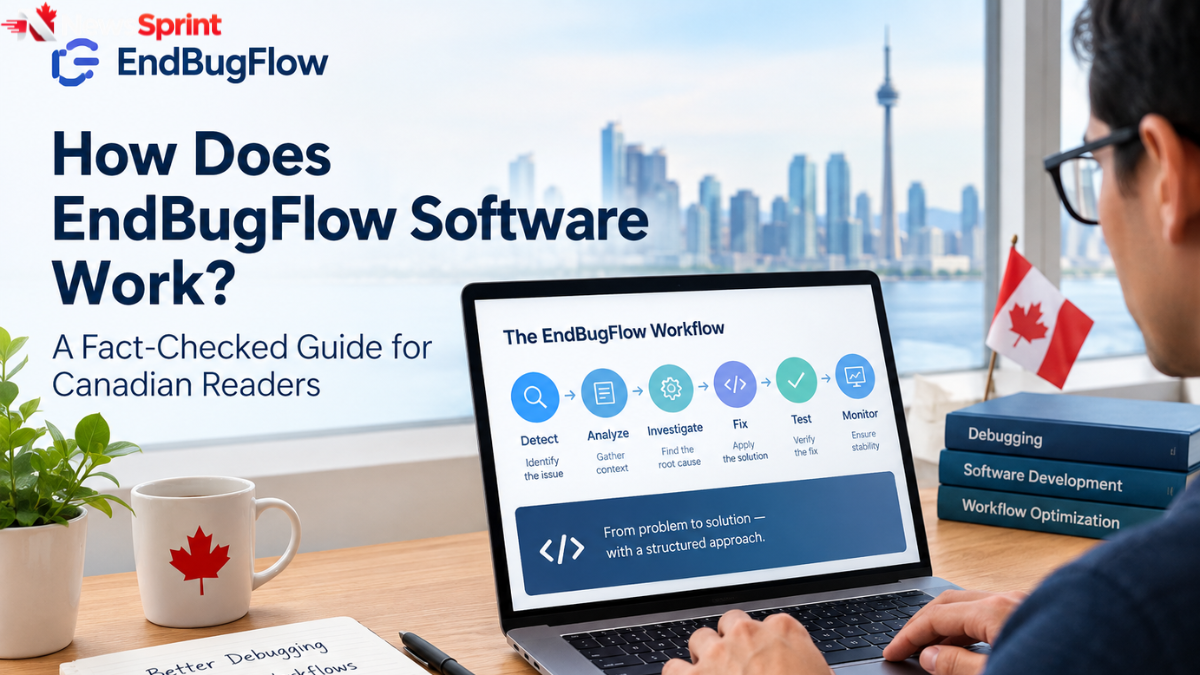
Detect → Understand → Investigate → Fix → Test → Monitor
This model is not unique to Endbugflow. It represents a widely used approach to software debugging and quality management. Endbugflow’s own material emphasizes structured problem-solving, debugging foundations, workflow optimization, and end-to-end approaches rather than treating an error as an isolated event.
1. Detecting a Software Problem
The process starts when something does not behave as expected.
A problem might appear as an application crash, an incorrect result, a failed automated test, a performance problem, a broken interface, or another unexpected behaviour. The first task is not necessarily to change code immediately. It is to establish what actually happened.
This distinction is important because symptoms and causes are often different.
For example, a web application might display an error page. The visible error could be caused by a database timeout, an authentication failure, malformed input, a network problem, or a programming error elsewhere in the request chain.
A structured debugging workflow therefore begins by collecting evidence instead of guessing.
2. Capturing Technical Context
Once an issue has been identified, developers need context.
Useful debugging information can include the error message, stack trace, application logs, operating environment, relevant input, recent code changes, and steps that reproduce the problem.
The exact information captured by any Endbugflow implementation is not fully established in public documentation. However, the principle is straightforward: a bug report becomes more useful when it contains enough technical context for another person to reproduce and investigate the failure.
This is particularly valuable for distributed development teams. A developer in Toronto may investigate an issue reported by QA in Vancouver or by a customer using a different operating system. Without sufficient context, the team may spend more time trying to reproduce the problem than solving it.
Understanding the Endbugflow Workflow
The term endbugflow workflow is best understood as a continuous process rather than a single button or feature.
The official Endbugflow material describes a workflow that begins with understanding the problem space and system behaviour. It then moves through analysis and refinement before applying optimized approaches. The stated goal is to reduce complexity and create more sustainable development practices.
| Workflow stage | Main purpose | Typical activity |
| Detection | Identify the problem | Observe an error or unexpected behaviour |
| Context gathering | Understand circumstances | Review logs, inputs, environment and recent changes |
| Analysis | Find likely causes | Examine traces, code paths and system behaviour |
| Reproduction | Confirm the issue | Recreate the failure under controlled conditions |
| Resolution | Correct the cause | Modify code, configuration or related components |
| Testing | Validate the correction | Run relevant tests and reproduce the original scenario |
| Monitoring | Confirm stability | Watch for recurrence or related failures |
This table describes the general debugging model rather than claiming that every stage is implemented as a specific Endbugflow software feature.
Endbugflow Features: What Can Be Confirmed?
Searching for Endbugflow features produces a mixture of information. Some features are associated with the broader Endbugflow approach, while others appear mainly in third-party descriptions.
The official website clearly emphasizes debugging frameworks, workflow optimization, technical concepts, and structured problem-solving. It also publishes explanations of stack traces and other debugging practices.
By contrast, claims about advanced product functionality such as automatic bug detection, AI-powered prioritization, specific integrations, detailed dashboards, or automated monitoring require more caution.
Debugging Guidance
One of the clearest characteristics of Endbugflow is its focus on debugging knowledge.
The official site discusses methods for identifying, tracing, and resolving software problems. Its stack-trace material, for example, explains how developers can use call information to understand where an error occurred and how execution reached that point.
This is useful because debugging is not simply about finding the line where an application crashed. The developer needs to understand the chain of events that produced the failure.
Workflow Optimization
Another major theme is digital workflow optimization.
The goal is to reduce unnecessary friction during software development. In practice, that can mean improving how teams investigate issues, reducing context switching, establishing clearer development processes, and creating repeatable approaches to technical problems.
The concept is particularly relevant to teams that handle frequent software releases. When debugging is performed inconsistently, the same categories of problems may consume time repeatedly.
End-to-End Debugging
End-to-end debugging means looking beyond the immediate error.
Suppose an online application fails during checkout. Looking only at the visible error message might identify the final symptom, but the actual cause could exist in the browser, API, authentication layer, database, payment service, or deployment configuration.
An end-to-end approach considers the complete chain.
That is consistent with Endbugflow’s stated focus on system-wide debugging perspectives and structured problem-solving.
Does EndBugFlow Automatically Fix Bugs?

This is an area where readers should be careful.
Some third-party articles describe Endbugflow as having increasingly automated capabilities, including automatic issue handling or advanced bug-management functionality. However, the public information available from Endbugflow itself does not provide enough technical documentation to confirm that it can independently diagnose and repair arbitrary software defects.
A debugging system can certainly automate parts of the process. It may collect logs, categorize events, create reports, trigger notifications, or connect development workflows. But automated detection is not the same thing as autonomous bug fixing.
A reliable distinction is:
Automation can assist debugging; it does not necessarily mean the software can independently solve the underlying programming problem.
Developers still need to understand the root cause, evaluate proposed changes, test fixes, and determine whether a change is safe to release.
How Stack Traces Fit Into the Process
Stack traces are particularly important in software debugging because they provide a record of the execution path associated with an error.
Endbugflow’s own technical material explains stack traces as a trail of function calls leading to a failure. Depending on the programming language and runtime, a trace can identify methods, files, line numbers, exception types, and related information.
Consider a simplified example:
TypeError
checkout.js:142
calculateTotal()
processOrder()
submitCheckout()
The developer does not necessarily fix the first line shown. Instead, they examine the execution path and surrounding application logic to understand why the unexpected value reached the failing operation.
This is where structured debugging becomes useful. A stack trace provides evidence, but interpretation still requires technical reasoning.
Endbugflow Automation: What Should Users Verify?
The term endbugflow automation appears frequently in third-party discussions, but automation claims should be evaluated carefully.
Before assuming that a software product automatically performs a particular action, users should verify the official documentation for that capability.
For example, if a product is said to automatically prioritize bugs, a prospective user should look for documentation explaining how priority is calculated. If an integration with another development platform is claimed, users should look for official integration documentation rather than relying on an unrelated blog post.
The same principle applies to AI features, automatic anomaly detection, repository integrations, deployment hooks, and automated notifications.
A feature can be technically plausible without being publicly verified as an actual product capability.
Endbugflow Software Setup
Information about endbugflow setup is another area where caution is appropriate.
The official Endbugflow website currently functions primarily as a technical content and information platform. Publicly available information does not provide the kind of complete installation documentation that users would normally expect from a mature commercial software product, such as a consistently documented installer, version history, official system requirements, API reference, pricing information, and security documentation.
That does not automatically mean the software is unsafe or that no software exists. It means that users should verify the source before downloading or connecting anything to sensitive systems.
For Canadian businesses, this is particularly important when software could access customer information, source code, credentials, logs, or internal infrastructure.
Endbugflow System Requirements and Compatibility
Claims about operating-system compatibility should also be verified before installation.
Third-party pages have described different forms of desktop compatibility, but publicly available information is not sufficiently consistent for a responsible article to state exact Windows, macOS, or Linux requirements as confirmed facts.
A trustworthy installation page should normally identify the supported operating systems, minimum hardware requirements, software dependencies, supported versions, installation method, update process, and official download location.
If those details are missing or inconsistent, users should pause before installing software from an unfamiliar source.
Is EndBugFlow a Traditional Bug Tracker?
Not necessarily, at least based on what can currently be verified.
A traditional bug tracker generally provides a clearly defined product environment for creating issues, assigning responsibility, changing statuses, adding comments, tracking history, and reporting on project activity.
Some third-party sources describe Endbugflow in exactly those terms. However, Endbugflow’s own website more clearly establishes it as a platform centred on technical knowledge, debugging frameworks, and workflow optimization.
That distinction matters for anyone comparing Endbugflow with established software-development platforms.
Rather than assuming that Endbugflow is equivalent to a mature issue-management product, users should verify whether the specific functionality they need is actually available.
| Capability | Publicly supported by Endbugflow’s own material? | Editorial assessment |
| Debugging guidance | Yes | Clearly supported |
| Technical concepts | Yes | Clearly supported |
| Workflow optimization | Yes | Clearly supported |
| End-to-end debugging frameworks | Yes | Clearly supported |
| Bug tracking dashboard | Not sufficiently documented | Verify before relying on it |
| Automatic bug fixing | Not sufficiently documented | Do not assume |
| AI bug prioritization | Not sufficiently documented | Verify independently |
| GitHub/Jira/Slack integrations | Reported by third parties | Require official confirmation |
| Detailed API documentation | Not clearly established | Verify before integration |
| Commercial pricing | Not clearly established | Check official product information |
| Production security controls | Not sufficiently documented | Require security documentation |
Why the Distinction Matters for Canadian Users
For Canadian developers and organizations, software evaluation should go beyond a feature list.
If a debugging tool receives application logs, source-code information, customer data, identifiers, or infrastructure details, privacy and security become important considerations.
Canadian organizations may also have contractual, regulatory, or internal requirements concerning where information is processed, who can access it, how long it is retained, and whether third parties receive it.
That does not mean Endbugflow should be considered unsafe. There is simply not enough public product documentation to make a definitive security assessment.
Before connecting a development repository or production environment, organizations should review the provider’s privacy policy, terms, security documentation, data-processing practices, access controls, retention policies, and breach-notification procedures.
Common Misconceptions About EndBugFlow
One common misconception is that Endbugflow is unquestionably a fully documented commercial bug-tracking application. The public evidence does not support such a confident conclusion.
Another misconception is that the presence of the word “software” in search results proves that a downloadable product with a specific set of features exists. Search results can contain third-party articles, republished descriptions, and pages using a term without establishing its technical provenance.
A third misconception is that automation automatically means autonomous debugging. Even sophisticated development systems usually require human review, especially when a proposed change can affect production systems.
The most responsible approach is therefore to distinguish between what Endbugflow publicly describes and what external websites claim about it.
How Endbugflow Could Fit Into a Development Process
If the Endbugflow approach is treated as a debugging methodology, its value is easier to understand.
Imagine a Canadian software team discovers that users are intermittently receiving failed checkout requests. Rather than immediately modifying the payment code, the team first records the exact conditions under which the failure occurs.
Developers then examine logs and traces, compare successful and failed requests, reproduce the problem, identify the responsible component, implement a targeted correction, and test the change. Once released, the team watches the system to determine whether the problem returns.
That process reduces guesswork.
The important point is that the value comes from connecting technical evidence to a repeatable workflow. Whether a specific Endbugflow product automates each of these steps is a separate question that requires product-level documentation.
What Developers Should Look For Before Using EndBugFlow
Anyone considering Endbugflow should evaluate it as they would any other development tool.
The first question should be who operates the product and where is the official product documentation? A legitimate software service should make its ownership and documentation reasonably clear.
The next issue is data handling. Developers should know what information the software collects and whether logs, source code, credentials, or customer information leave their environment.
Technical teams should also verify integration support rather than assuming compatibility with GitHub, Jira, Slack, CI/CD platforms, or other tools simply because a third-party article mentions them.
Finally, teams should test the software in a controlled environment before introducing it into production. A staging project can reveal compatibility, performance, permissions, data-flow, and workflow issues without exposing the organization to unnecessary operational risk.
Endbugflow Software Capabilities: Confirmed vs. Reported
A useful way to evaluate the current information is to divide it into two categories.
The confirmed side includes Endbugflow’s publicly stated emphasis on debugging, technical concepts, workflow optimization, and end-to-end problem-solving frameworks. These themes are visible directly on its website.
The reported side includes more specific claims about software automation, issue tracking, integrations, monitoring, automated prioritization, and advanced product infrastructure. These appear in third-party material but are not sufficiently established by the primary public documentation available for independent verification.
This distinction is not a criticism. It is simply good technical research practice.
When evaluating a relatively unfamiliar technology product, readers should not confuse repeated claims across blogs with independent confirmation.
My Opinion on How Does EndBugFlow Software Work
My view is that the most useful way to understand Endbugflow right now is to focus on the debugging methodology it publicly promotes rather than assuming every third-party software claim is proven.
The underlying approach makes practical sense. Developers need structured methods for detecting problems, collecting evidence, reading traces, identifying root causes, applying fixes, and validating the result. Endbugflow’s public material is strongest when it explains these ideas.
Where I would be more cautious is in treating Endbugflow as a fully documented commercial software platform without first checking its current official product documentation. The gap between the official site’s clear debugging focus and the much broader capabilities described on some third-party sites deserves attention.
For someone researching the keyword how does EndBugFlow software work, that is actually an important finding. A good explanation should not manufacture certainty where the available evidence does not support it.
If you are considering using the product, verify the official download source, ownership, documentation, supported integrations, pricing, privacy practices, security controls, and current release information before connecting it to real development infrastructure.
Frequently Asked Questions About How Does EndBugFlow Software Work
How does EndBugFlow software work in simple terms?
Endbugflow is publicly associated with a structured approach to software debugging and workflow optimization. The general process involves identifying a problem, collecting technical context, analysing evidence, finding the likely cause, applying a fix, testing the result, and monitoring the system afterward. The exact implementation of these steps as product features is not fully documented publicly.
What is Endbugflow software used for?
Public Endbugflow material focuses on debugging, technical concepts, workflow optimization, and end-to-end approaches to resolving software problems. Some third-party sources describe it as a bug-tracking or issue-management product, but those additional capabilities should be verified against official documentation.
Does Endbugflow automatically fix software bugs?
There is not enough reliable public documentation to confirm that Endbugflow can independently fix arbitrary software bugs. Automation may assist with parts of a debugging workflow, but developers should not assume that detection or workflow automation means autonomous code repair.
Is Endbugflow available for Canadian developers?
The public material does not provide enough consistently documented information to confirm a specific Canadian availability model, pricing structure, or regional service arrangement. Canadian users should check the current official product information before signing up, downloading software, or connecting development systems.
Is Endbugflow safe to use?
The available public information is insufficient to make a definitive security assessment. Before using it with source code, logs, customer information, or production infrastructure, users should verify the official download source and review privacy, security, data-retention, access-control, and data-processing documentation.
Conclusion
So, how does EndBugFlow software work? The most defensible answer is that Endbugflow is publicly centred on structured software debugging, technical problem-solving, and workflow optimization. Its documented philosophy moves from understanding a technical problem through analysis, refinement, resolution, and longer-term stability.
At the same time, readers should be careful with highly specific claims about Endbugflow software features. The public evidence does not independently confirm every capability attributed to the product by third-party websites. Features such as advanced automation, specific integrations, AI-driven prioritization, detailed monitoring, and autonomous bug fixing should therefore be treated as unverified until supported by authoritative product documentation.
For Canadian developers and organizations, the practical lesson is simple: evaluate the debugging methodology, but verify the actual product before trusting it with real development infrastructure. Check who operates it, what it can access, where data goes, how updates work, and whether the features your team needs are officially documented.
That evidence-first approach gives you a much more reliable understanding of how does EndBugFlow software work than simply repeating the most confident claims appearing in search results and more.
