

Table of Contents
Introduction
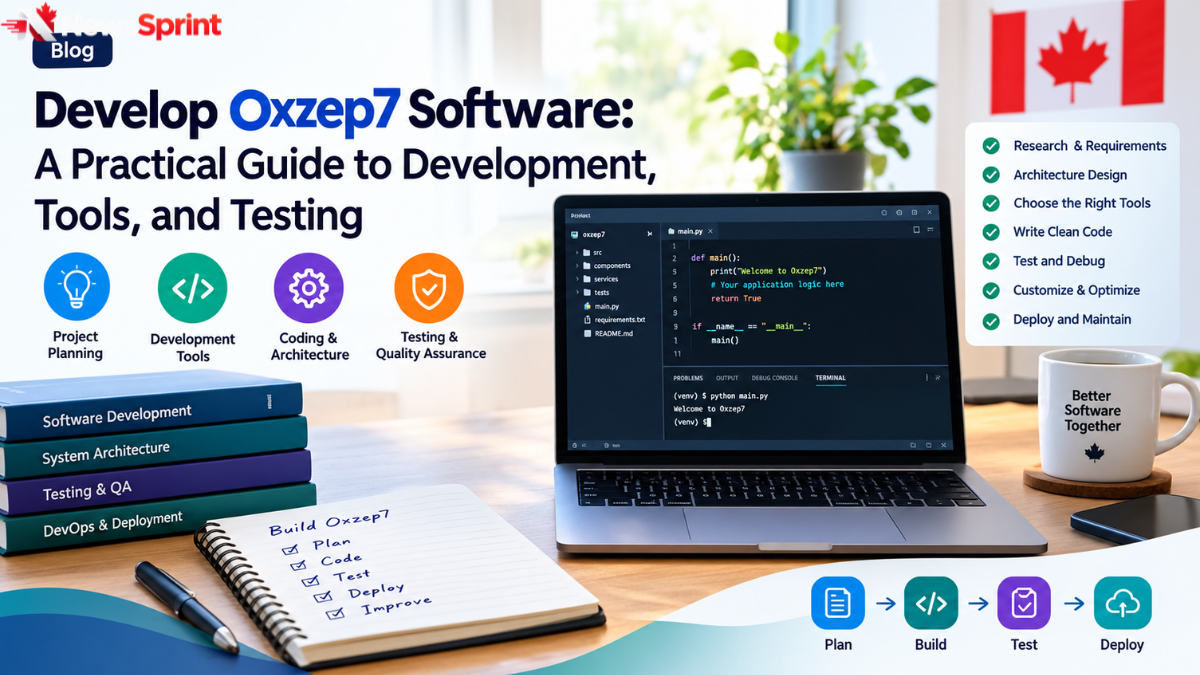
The search phrase develop oxzep7 software has appeared in several recent technology articles, but its meaning is not consistent. Some websites describe Oxzep7 as a software-development framework, while others present it as an automation platform, proprietary enterprise system, or conceptual approach to building applications. These descriptions do not establish one verified, universally recognized software product.
This creates a challenge for Canadian developers, students, business owners, and technology readers who want to understand how to develop Oxzep7 software. A useful guide must explain the development process without presenting unverified technical claims as established facts.
The most reliable approach is to begin with project identification. Before choosing a programming language, installing dependencies, or designing an architecture, developers need to know whether Oxzep7 refers to a genuine public package, an internal company project, a proprietary application, or a newly proposed software concept.
This guide explains the available information, the practical development workflow, software architecture, development tools, customization, testing, troubleshooting, and important considerations for Canadian users. It also explains which details remain uncertain and how to verify them before starting implementation.
What Is Oxzep7 Software?
Oxzep7 does not currently have one consistently verified public definition in the sources reviewed. Online articles use the name in different contexts, including software frameworks, automation systems, proprietary platforms, and conceptual development methods.
Consequently, it would be inaccurate to state that Oxzep7 is definitively a Python framework, a JavaScript library, an enterprise integration platform, or a particular software protocol. The available articles do not provide a consistent technical specification that establishes one of these identities.
The phrase “develop Oxzep7 software” can instead be understood as a request to build or modify a software project associated with the Oxzep7 name. The exact development process depends on the project’s real purpose and technical requirements.
Understanding the Software Identity
A software product’s name does not automatically establish its programming language, architecture, capabilities, or installation method.
For a publicly documented development platform, readers would normally expect a recognizable official website, technical documentation, source repository, package information, version history, and installation instructions. These resources help establish what the software does and how developers should use it.
For Oxzep7, the sources reviewed do not provide a sufficiently consistent public technical foundation to confirm those details.
This does not prove that no private project named Oxzep7 exists. An organization can maintain an internal application or proprietary module without publishing its code or documentation. It does mean that developers should not treat general online descriptions as official technical instructions.
What Online Research Reveals About Oxzep7
Several recent websites publish articles using the develop oxzep7 software keyword. Their descriptions differ substantially.
One article describes Oxzep7 as an uncertain software term and emphasizes the absence of a clearly verifiable mainstream package or framework. Another presents it as a proprietary system for enterprise integrations. Other articles describe a modular efficiency framework, a conceptual software-development approach, or a general application-building process.
The following table separates those descriptions from what can responsibly be concluded.
| Topic | What the reviewed sources indicate | Verification status |
| Oxzep7 identity | Different websites use different definitions | No single verified definition |
| Programming language | Some articles mention Python or JavaScript-related development | No official language requirement established |
| CLI commands | Certain pages publish commands such as project initialization and development commands | Commands not independently verified |
| Software architecture | Articles discuss modular or layered designs | No official Oxzep7 architecture established |
| Security features | Some descriptions associate the term with secure systems | No verified product-specific security specification |
| Performance | Some pages make efficiency or scalability claims | No independently verified benchmark established |
| Public availability | Some sources describe private or unavailable software | Public distribution status remains uncertain |
The central lesson is that an article mentioning a software feature does not prove that the feature exists in an official product. Reliable development guidance requires a primary source or reproducible evidence.
Why Conflicting Descriptions Matter
When different websites repeat different explanations, readers may assume that all of them describe the same technology. That assumption can lead to incorrect installation steps, unsuitable programming tools, or wasted development effort.
For example, an article may provide a command that appears to initialize an Oxzep7 project. Without a verified executable, official documentation, or reproducible demonstration, there is no sound basis for treating that command as genuine.
A fact-checked guide should therefore distinguish between the existence of online content about Oxzep7 and the existence of a confirmed, usable software platform.
How to Develop Oxzep7 Software: Start With Project Requirements
The first practical step in developing any software is understanding the problem it must solve.
If Oxzep7 is the name of a new application, the development team should define its purpose, intended users, required functionality, data needs, and operating environment. If it is an existing proprietary project, the team should obtain its official requirements from the responsible organization.
A project specification should explain what users need to accomplish and what the software must do to support those tasks.
Define the Main Objective
A software project needs a clear objective. The objective might involve managing records, automating a business process, processing information, providing a customer interface, or supporting internal operations. These are examples of possible goals, not verified Oxzep7 capabilities.
A clear objective helps prevent unnecessary features and gives developers a way to evaluate whether the completed application solves the intended problem.
Identify the Target Audience
The intended users influence interface design, accessibility, security, and technical complexity.
A tool for professional developers may require command-line functionality and detailed technical documentation. A customer-facing application may need a simple interface, account management, and clear error messages. An internal business system may prioritize permissions, reporting, and integration with existing tools.
For a Canadian audience, the project should also consider the users’ language, accessibility needs, industry requirements, and applicable privacy obligations.
Document Functional Requirements
Functional requirements describe what the software must do. For example, a project might require users to create accounts, submit forms, search records, generate reports, or communicate with another service.
Each requirement should be specific enough to test. A statement such as “the system should be fast” is less useful than a defined response-time target measured under a particular workload.
The actual requirements for Oxzep7 cannot be inferred from its name. They must come from the verified project specification.
Oxzep7 Software Development Guide: Planning the Architecture
Software architecture defines the structure of an application and the relationships between its components.
For a new software project, architecture should follow the requirements rather than an assumed Oxzep7 specification. A simple application may need only a user interface, application logic, and data storage. A more complex system may require additional services, integrations, monitoring, and access controls.
Presentation Layer
The presentation layer handles how users interact with the application. It may be a web interface, desktop interface, mobile interface, or command-line experience.
Its responsibilities include displaying information, collecting input, and communicating with the application’s underlying logic. The appropriate technology depends on the target platform and user requirements.
Application Logic
The application layer coordinates operations and responds to user requests. It may validate input, call business functions, communicate with databases, and return results.
Keeping application logic organized makes the code easier to understand and test. The exact structure should be selected according to the project’s size and complexity.
Data Layer
The data layer manages information storage and retrieval. Depending on the application, it might use a relational database, document database, local files, or another storage system.
The choice depends on data structure, query requirements, reliability, scale, and maintenance needs. No particular database can be identified as an official Oxzep7 requirement from the reviewed sources.
Integration Layer
An application may need to communicate with external services, payment providers, business systems, or other software. Integration design should specify data formats, authentication, error handling, and service dependencies.
Developers should verify each external integration before relying on it in production.
Choosing Oxzep7 Development Tools
Selecting development tools is one of the most important technical decisions in a software project. The correct tools depend on the project’s verified language, runtime, architecture, and deployment environment.
Programming Language
There is no independently established official programming language for Oxzep7 in the reviewed sources. Some online articles associate the keyword with Python or JavaScript-related development, but those descriptions do not establish a mandatory language choice.
For a new project, choose a language based on the application’s requirements, available developer skills, library ecosystem, and long-term maintenance needs.
Code Editor or IDE
A code editor or integrated development environment helps developers write, navigate, debug, and organize source code.
The tool should support the selected programming language and provide useful features such as syntax highlighting, error detection, debugging, and source-control integration.
There is no verified Oxzep7-specific editor requirement.
Version Control
Version control records changes to source code and supports collaboration. Git is a widely used option for managing software projects.
A repository can help developers review changes, maintain branches, identify regressions, and restore earlier versions. It is useful for new applications and internal development projects alike.
Dependency Management
Software often depends on external libraries and packages. A dependency-management system helps install and maintain those components.
Developers should use the package manager appropriate to the verified technology stack. They should also check package names, publishers, versions, and sources before installing unfamiliar dependencies.
Documentation Tools
Project documentation should describe setup, configuration, development, testing, and deployment. A well-maintained README and technical specification can reduce onboarding problems and help future developers understand the system.
For an unfamiliar project such as Oxzep7, documentation is especially important because the name alone does not explain the software’s function.
How to Develop Oxzep7 Software Safely

Once the project has been identified, developers can begin implementation in a controlled environment.
The following process describes general software-development practices. It does not claim to be an official Oxzep7 workflow.
Establish an Authoritative Source
First, locate the project’s legitimate source. It may be an official repository, a private organization server, a vendor portal, or a local project directory.
If the project belongs to a company or client, obtain permission and use the approved development resources. Avoid downloading supposed SDKs or command-line tools from unrelated websites.
Review the Documentation
Read the available setup instructions before running commands. Check the supported operating systems, language versions, dependencies, environment variables, and testing procedures.
If documentation is incomplete, inspect the project’s configuration files and consult the responsible maintainer. Do not fill missing instructions with guesses from another technology.
Create an Isolated Development Environment
An isolated environment helps prevent project dependencies from interfering with other applications.
For a verified Python project, developers can use Python’s built-in virtual-environment mechanism:
Bash
python -m venv .venv
The command creates a virtual environment for a Python project. It is a general Python development technique, not evidence that Oxzep7 is a Python framework or that the project officially requires Python.
After creating the environment, activate it according to the operating system and install only the dependencies specified by the verified project.
Record the Environment
Developers should document the runtime version, dependency versions, operating system, and configuration required to run the project.
For Python, example diagnostic commands include:
python –version
python -m pip –version
python -m pip freeze
These commands help establish a baseline for troubleshooting. They do not verify the existence of an Oxzep7 package.
Run Existing Tests
Before modifying a project, run its existing test suite if one is available. This helps establish whether the original code works in the development environment.
Record any failures and investigate them before making substantial changes. A clean baseline makes later debugging more manageable.
Oxzep7 Software Programming and Coding Techniques
Programming involves translating requirements into working code. The most effective coding techniques depend on the project’s language and architecture, but several principles apply broadly.
Write Clear and Focused Functions
A function should have a clear responsibility. When a single function performs unrelated tasks, the code becomes harder to test and maintain.
For example, a record-processing application might separate input validation, data transformation, and storage operations. This structure allows each part to be tested independently.
Use Meaningful Names
Variables, functions, and modules should have names that explain their purpose. Clear naming reduces confusion and makes the code easier for other developers to maintain.
Avoid unexplained abbreviations and inconsistent terminology, particularly when the project uses unfamiliar domain-specific concepts.
Validate Inputs
Applications should validate input before processing it. Validation can identify missing fields, invalid formats, unexpected values, and other errors.
The validation rules should be based on the actual requirements. A financial application, for example, may need different rules from a simple note-taking tool.
Handle Errors Clearly
Errors should be handled in a way that helps users and developers understand what happened.
A user-facing message should be understandable without exposing sensitive internal details. Developers should maintain appropriate logs and diagnostic information while protecting credentials and personal data.
Document Important Decisions
Technical documentation should explain significant design choices, dependencies, configuration requirements, and known limitations.
This is especially useful when future developers need to understand why a particular implementation was selected.
Oxzep7 Software Customization
Customization involves adapting a software application to meet specific needs.
If Oxzep7 is an existing proprietary system, customization should follow the permissions and extension mechanisms provided by its owner. If it is a new application, customization can be incorporated into the original requirements and architecture.
Configuration-Based Customization
Some applications support customization through configuration settings rather than source-code changes. These settings may control user preferences, business rules, interface behavior, or integrations.
Whether Oxzep7 supports configuration-based customization is not established by the reviewed sources.
Feature Customization
A development team may add features when the software architecture supports extensions. Before making changes, developers should understand how the modification affects existing functionality, testing, security, and future updates.
Avoid Unsupported Modifications
Do not assume that an unfamiliar software system can safely be modified by editing arbitrary files or installing unofficial extensions. Changes should be tested and documented, particularly when the application handles business or personal information.
Oxzep7 Software Testing and Quality Assurance
Testing determines whether software meets its requirements and behaves correctly under expected conditions.
A reliable Oxzep7 development process should include testing appropriate to the actual application. The following categories are general software-engineering practices, not confirmed Oxzep7-specific testing requirements.
Functional Testing
Functional testing checks whether individual features perform their intended tasks.
For example, if an application allows users to create records, tests should verify successful creation, invalid input handling, duplicate records, and appropriate error messages.
Integration Testing
Integration testing checks whether separate components communicate correctly.
A system might need to connect its application logic to a database, an external API, or another internal service. Integration tests help identify problems that may not appear when components are tested separately.
Security Testing
Security testing examines weaknesses that could expose data or allow unauthorized actions.
Important areas may include authentication, authorization, input validation, session management, secure configuration, and protection of sensitive information.
The appropriate security controls depend on the application’s purpose, users, and data.
Performance Testing
Performance testing evaluates application behavior under a defined workload.
Developers should establish measurable targets, select representative test scenarios, and record results. Claims that Oxzep7 provides superior performance should not be accepted without credible, reproducible evidence.
User Acceptance Testing
User acceptance testing determines whether the software meets the needs of its intended users.
A development team can provide representative users with realistic tasks and gather feedback about usability, missing functionality, and workflow problems.
Oxzep7 Software Compatibility
Compatibility refers to whether software works correctly with the environments and components it is expected to support.
For a verified project, compatibility may involve operating systems, runtime versions, hardware, databases, browsers, external services, or other dependencies.
The available sources do not establish an official Oxzep7 compatibility matrix. Therefore, developers should not claim that the software supports a particular operating system or programming environment without reliable documentation.
Testing Compatibility
A practical compatibility process begins by identifying the supported environments from the project specification. Developers can then test the application in those environments and record the results.
This approach is more reliable than assuming that a software project will work everywhere because an online article describes it as flexible or scalable.
Oxzep7 Software Troubleshooting
Troubleshooting involves identifying the cause of a problem and applying a controlled solution.
When working with unfamiliar software, the first step is to reproduce the issue and record the relevant information.
Installation Problems
Installation failures may result from incorrect dependencies, incompatible versions, missing permissions, or incorrect configuration.
Developers should compare the environment with the verified installation requirements before changing system settings or installing additional packages.
Runtime Errors
Runtime errors occur while the application is executing. They may result from invalid input, missing resources, unexpected data, or programming defects.
A useful troubleshooting process includes examining the error message, checking logs, identifying the affected operation, and testing a focused correction.
Configuration Problems
Incorrect environment variables, connection settings, or file paths can prevent an application from working correctly.
Configuration should be documented and reviewed carefully. Sensitive credentials should not be exposed in source code or public logs.
Unverified CLI Commands
Several online pages publish supposed Oxzep7 commands, but the reviewed material does not establish that these commands belong to a verified official software distribution.
Developers should not execute unfamiliar commands merely because they appear in a tutorial. Verify their source and understand their effects before using them.
Developing Oxzep7 Software for Canadian Users

The Canadian target audience makes it useful to consider regional requirements, but it does not establish a particular Oxzep7 architecture or feature set.
A Canadian software project may need to consider the type of users, industry, data processed, hosting arrangements, accessibility, and applicable privacy requirements.
Privacy and Personal Information
Applications that handle personal information should be designed with appropriate privacy and security practices. The relevant obligations depend on the organization, the information involved, and the jurisdictions in which the software operates.
For authoritative guidance, developers should consult the Office of the Privacy Commissioner of Canada’s official resources and determine which legal requirements apply to their project.
Accessibility
A public-facing application should consider accessibility during design and testing. Clear navigation, understandable labels, keyboard support, and appropriate interface behavior can improve usability for a wider range of users.
The specific accessibility requirements depend on the application and the organization responsible for it.
Language and User Experience
The intended Canadian audience may include users who prefer English or French. A project serving both language communities should assess whether multilingual interface support is necessary.
Language requirements should be determined during planning rather than added after development without considering the interface and content structure.
Challenges When You Develop Oxzep7 Software
Unclear Project Identity
The main challenge is that online descriptions do not establish a single verified technical identity for Oxzep7. This makes it difficult to confirm its official features, programming language, and installation process.
The solution is to locate authoritative documentation before selecting a technology stack.
Incomplete Documentation
A project with limited documentation can be difficult to install, understand, and maintain. Developers may need to consult maintainers, inspect source code, and document their own findings.
If the software is proprietary, the responsible organization should provide the approved technical information.
Compatibility Uncertainty
Without a verified compatibility specification, developers cannot confidently claim support for particular operating systems, runtimes, or dependencies.
Controlled testing is necessary to establish what works in the intended environment.
Security Risks
Installing unverified packages or executing unknown commands can create security risks. Developers should verify software sources, review dependencies, protect credentials, and use controlled environments.
Security should be considered throughout the development lifecycle rather than only after the application is complete.
Maintenance Requirements
Software requires ongoing maintenance, including bug fixes, dependency updates, testing, documentation, and security reviews.
A development plan should assign responsibility for maintenance and establish a process for managing future changes.
My Opinion on Develop Oxzep7 Software
My opinion is that developers should approach the develop oxzep7 software keyword with careful verification and a practical development mindset.
The available articles demonstrate that people are publishing content about Oxzep7, but they do not establish one reliable, universally accepted technical definition. The conflicting descriptions make it difficult to recommend a specific official SDK, programming language, CLI, or architecture as though it were confirmed.
For a new software project, the sensible approach is to define the problem first and then select technologies that meet the requirements. For an existing proprietary project, the correct approach is to obtain documentation and access from the responsible organization.
This distinction protects developers from wasting time on unsupported instructions. It also helps publishers produce useful content that does not turn uncertain online claims into technical facts.
The most valuable next step is to establish what Oxzep7 represents in the reader’s specific context. Once that identity is verified, the development process can become much more precise.
Frequently Asked Questions About Develop Oxzep7 Software
1. What does develop oxzep7 software mean?
The phrase generally refers to building or modifying software associated with the Oxzep7 name. However, the available sources do not establish one universally verified Oxzep7 platform, so its exact meaning depends on the project being referenced.
2. Is Oxzep7 an official programming framework?
The reviewed sources do not provide sufficient independent evidence to confirm Oxzep7 as a universally recognized public programming framework. Some articles describe it as a framework, but those descriptions should be verified through authoritative technical documentation.
3. Which programming language is needed to develop Oxzep7 software?
No official programming language requirement has been established by the sources reviewed. The correct language depends on the verified project’s documentation or, for a new application, its technical requirements.
4. How can beginners start developing Oxzep7 software?
Beginners should first identify the actual project, locate trustworthy documentation, understand its requirements, select suitable development tools, create a controlled environment, and learn the programming concepts relevant to the chosen technology stack.
5. Is Oxzep7 software publicly available?
The public availability of a clearly identifiable official Oxzep7 software product has not been established by the sources reviewed. Some websites describe it as private or unavailable, but those descriptions alone do not confirm its ownership or distribution status.
Conclusion
To develop oxzep7 software responsibly, begin by identifying the actual project and verifying its technical requirements. The name appears in online technology content, but conflicting descriptions prevent a confident claim about one official framework, programming language, or development environment.
Once the project is verified, standard software-engineering practices can guide requirements gathering, architecture, programming, testing, security, and deployment. This process provides a practical foundation for developers and Canadian technology readers without relying on unsupported claims.
The key lesson is straightforward: establish what the software is before deciding how to build it and more.
