

Table of Contents
Introduction
Searching for gdtj45 builder software can lead to a confusing mix of technology articles, feature descriptions, and questions about whether the software is real. The central issue is that the name does not yet have a clearly established identity in the reliable public documentation reviewed for this article.
Several online pages describe GDTJ45 as a builder or development platform, sometimes associating it with visual design, modular components, and code editing. Other pages question whether it represents a publicly released product at all. These descriptions cannot independently establish the existence, capabilities, or availability of a particular software application.
For Canadian readers interested in software development, that distinction matters. A useful guide should explain what is actually known, identify the claims that remain unverified, and show how to investigate an unfamiliar software name without relying on unsupported marketing statements.
This article examines the available descriptions of GDTJ45 Builder Software, explains the real software-development concepts associated with builder tools, discusses safe installation and verification practices, and considers established alternatives for people who need to build applications or manage software projects.
What Is GDTJ45 Builder Software?
GDTJ45 Builder Software is a term used in several online articles to describe a possible software-building or development tool. However, the available material does not establish a consistent product identity, verified developer, official feature documentation, or confirmed public download.
One article describes the term as a modular development platform, while another presents it as an unverified software name. These are descriptions published online, not proof of a recognized product.
The distinction between a software concept and a verified product is essential. Visual builders, code editors, reusable modules, and automated development workflows are all genuine concepts in software engineering. Their existence does not demonstrate that a specific tool called GDTJ45 provides them.
For Canadian readers, the practical takeaway is to investigate the software’s identity before trusting any claims about its functions, pricing, compatibility, or performance.
What the Available Research Reveals
The search results show that GDTJ45 has been discussed across multiple websites, but the descriptions are inconsistent. Some articles associate it with application development, while others question whether it is a publicly released tool.
| Information category | What can currently be established |
| Software name | GDTJ45 Builder Software |
| Product identity | Not clearly verified |
| Developer or owner | Not independently established |
| Official documentation | Not confirmed in the reviewed sources |
| Exact features | Unverified |
| Installation process | No confirmed official procedure |
| Pricing | Not established |
| Public availability | Unclear |
This table summarizes the research limitation rather than claiming that the software is definitively nonexistent. A private internal tool, an unreleased project, or a product with a different spelling could explain some of the uncertainty. However, none of those possibilities has been established as the identity of GDTJ45.
Why GDTJ45 Builder Software Is Difficult to Verify
The main challenge surrounding GDTJ45 Builder Software is not a technical problem with the software itself. It is the lack of a consistently documented product identity.
Several online articles use similar language to describe GDTJ45, including references to builder tools, modular development, and code editing. Yet the reviewed sources do not provide a reliable, unified specification that establishes which features belong to a confirmed product.
Conflicting Descriptions
A technology product normally has a recognizable identity. Its developer, documentation, supported systems, and release information help users understand what they are evaluating.
GDTJ45 does not have that level of clarity in the sources reviewed. One article describes it as a possible development platform, while another argues that it may be an unverified or fabricated software name. These conflicting descriptions should not be treated as equivalent evidence.
Repeated Claims Are Not Independent Verification
A feature can appear in many blog articles without being confirmed by the product’s developer. For example, if several websites repeat that a tool supports drag-and-drop design, that repetition alone does not establish that the tool actually offers the capability.
Reliable verification requires stronger evidence, such as official documentation, a legitimate product repository, identifiable release information, or a demonstrable application from a trustworthy source.
This principle applies to all software research, particularly when an unfamiliar name appears frequently in search results.
GDTJ45 Builder Software Features: Confirmed Versus Reported
Search results associate GDTJ45 with several possible features. However, the available evidence does not verify that these capabilities belong to an identifiable, publicly available product.
The following table separates common builder-software concepts from GDTJ45-specific verification.
| Feature or capability | General software meaning | GDTJ45 verification |
| Visual building | Designing interfaces through graphical controls | Not confirmed |
| Code editing | Modifying source code directly | Not confirmed |
| Reusable components | Using shared modules in different parts of a project | Not confirmed |
| Project templates | Starting from a predefined structure | Not confirmed |
| Testing tools | Checking software behaviour and detecting errors | Not confirmed |
| Team collaboration | Multiple people working on a project | Not confirmed |
| Version control | Tracking and managing code changes | Not confirmed |
Visual Building
A visual builder lets users arrange interface elements through a graphical environment. Depending on the product, users might design forms, pages, dashboards, or application screens without manually writing every interface element.
This is a real approach used by established development platforms. Microsoft Power Apps, for example, provides canvas apps that allow users to design interfaces and connect them to data sources.
However, there is no verified evidence in the reviewed material that GDTJ45 includes the same functionality.
Code Editing
Code editing refers to creating or modifying source code using an editor. Some development environments combine visual design with programming, allowing users to move between graphical controls and code.
This distinction matters because a builder that generates interfaces is not necessarily a full programming environment. Users need to know whether a tool supports source-code access, custom logic, debugging, and exportable project files.
For GDTJ45, those details remain unconfirmed.
Reusable Components
Modular development divides a project into smaller, manageable parts. A component might represent a form, a user interface element, a data-processing function, or a service connection.
The approach can improve organization and maintenance when implemented properly. Yet the general value of modular software design should not be confused with proof that GDTJ45 implements it.
How Does GDTJ45 Builder Software Work?
There is no verified technical documentation available in the reviewed sources that explains how GDTJ45 actually operates. Consequently, it would be misleading to provide a product-specific workflow as if it had been tested or documented by its creator.
A general builder-software workflow can nevertheless help readers understand what information to look for.
Project Creation
A genuine builder platform typically provides a way to create a new project. The process may involve choosing a template, selecting a project type, or configuring an initial workspace.
The exact process depends on the software. Some tools create projects through a browser, while others use a desktop application or a command-line interface.
No specific project-creation procedure has been verified for GDTJ45.
Interface and Component Design

Many application builders allow users to arrange interface elements such as text fields, buttons, menus, and data displays. These elements may be configured through visual controls or code.
Microsoft’s official Power Apps documentation describes canvas apps as customizable interfaces that can connect to different data sources and be adapted for business workflows.
That is an example of how an established builder works, not a confirmed description of GDTJ45.
Data and Logic
Software applications often need to store information, validate user input, and perform operations. A builder may provide database connectors, formulas, APIs, or programming interfaces for these tasks.
For example, an inventory application might need to retrieve product records, calculate stock levels, and display results. A suitable development platform should document how it handles these operations.
There is no reliable evidence in the reviewed sources establishing which data systems or programming interfaces GDTJ45 supports.
Testing and Deployment
A complete development workflow usually includes testing before an application reaches its intended users. Developers may check functionality, security, performance, and compatibility.
Deployment refers to making a finished application available in its target environment. Depending on the platform, that might mean publishing a website, releasing a mobile application, or deploying a business tool.
GDTJ45’s testing and deployment procedures have not been verified.
GDTJ45 Builder Software Development: Understanding the Real Concepts
The phrase “gdtj45 builder software development” suggests an interest in using the term within a programming or application-building context. The difficulty is that the specific development model associated with GDTJ45 has not been established.
Instead of assuming an undocumented architecture, it is more useful to understand the established concepts that a genuine builder platform might involve.
Low-Code Development
Low-code development uses visual interfaces, configurable components, and simplified development tools to reduce the amount of manually written code required for certain applications.
Microsoft Power Apps is a documented example. Its platform supports canvas apps, model-driven apps, data connections, and developer extensions.
Low-code does not mean that every application can be built without technical knowledge. Complex data models, security rules, integrations, and performance requirements can still require professional development skills.
Code-First Development
Code-first development gives programmers direct control over the application’s source code, architecture, dependencies, and implementation.
A code-first workflow may offer more flexibility for specialized software, but it can also require greater technical knowledge. Developers generally need to understand programming languages, testing, deployment, and maintenance.
GDTJ45’s position on the low-code-to-code-first spectrum is not confirmed.
Modular Architecture
A modular architecture organizes software into components with defined responsibilities. For example, a business application might separate its interface, authentication, data access, and reporting logic.
This structure can make projects easier to maintain, but its success depends on sound design and clear interfaces between components. Simply calling a tool “modular” does not establish how well it implements those principles.
GDTJ45 Builder Software Tools: What Should Users Look For?
People searching for GDTJ45 builder software tools may be trying to identify editors, development environments, testing utilities, or project-management functions associated with the name.
Since no reliable tool inventory has been established, users should evaluate any claimed tool against practical requirements.
Documentation
Documentation should explain what the software does and how to use it. Useful documentation generally includes installation instructions, supported environments, configuration guidance, and troubleshooting information.
A vague description of features is not a substitute for technical documentation.
Compatibility
Compatibility concerns whether the software works with a particular operating system, browser, programming environment, device, or data source.
For Canadian users, compatibility may also matter when a tool must operate within an organization’s existing technology infrastructure. However, no verified compatibility matrix is available for GDTJ45.
Support and Maintenance
A dependable software product should provide some way to obtain assistance or learn about updates. Depending on the product, that might include documentation, issue tracking, customer support, or release notes.
The absence of verifiable support information makes it difficult to assess whether an unfamiliar tool is suitable for an important project.
GDTJ45 Builder Software Installation and Setup
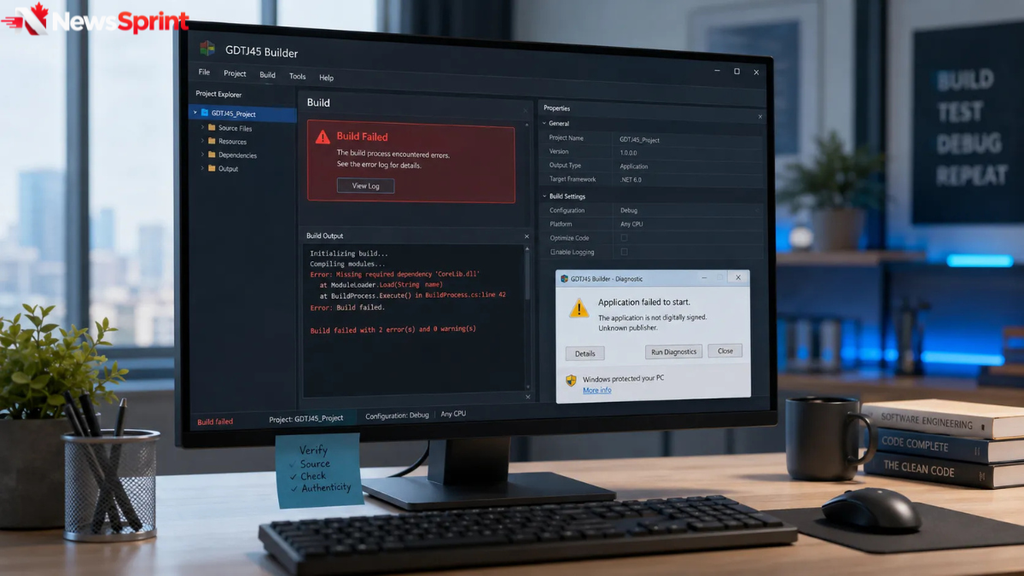
No confirmed official installation guide for GDTJ45 Builder Software has been established through the reviewed research. Therefore, specific instructions such as downloading a particular installer, running a command, or configuring a named account would be speculative.
The safest approach is to verify the software before attempting installation.
Identify the Original Source
Start by locating the developer’s official website or a recognized project repository. Check whether the source identifies the creator, explains the product, and provides consistent documentation.
A page that merely repeats a software name without identifying its origin is not sufficient evidence of authenticity.
Verify the Installer
If an installer is offered, examine its source and file details before opening it. An unfamiliar executable should not be trusted simply because its filename contains the expected software name.
For work computers, follow your organization’s software-approval procedures. For personal computers, use reputable security tools and avoid bypassing operating-system warnings without understanding the reason.
Review Permissions
An application may request access to files, networks, accounts, or other system resources. Those permissions should be appropriate for its documented purpose.
If the software’s identity and purpose are unclear, users should avoid granting broad permissions until they have verified what they are installing.
Confirm the Setup Process
A legitimate setup guide should explain prerequisites, installation steps, configuration, and any required accounts or licenses.
Without such information, there is no responsible way to provide a product-specific setup tutorial for GDTJ45.
GDTJ45 Builder Software Testing and Troubleshooting
The phrase “gdtj45 builder software testing” may be used by people seeking information about software errors or development quality. However, no verified GDTJ45 testing framework or error database has been identified.
A general testing process can still explain what a genuine builder platform should support.
Functional Testing
Functional testing checks whether an application performs its intended tasks. For a simple form, that might include entering information, submitting it, and confirming that the expected result appears.
The test should be based on documented requirements rather than assumptions about what an unknown product is supposed to do.
Compatibility Testing
Compatibility testing checks whether software behaves correctly in its supported environments. This can include browsers, operating systems, devices, or connected services.
The relevant environments must be known before a meaningful compatibility test can be designed.
Security Testing
Security testing examines risks such as unauthorized access, unsafe input handling, and inappropriate permissions. It is particularly important when software handles personal information or business data.
An unfamiliar application should not be trusted with sensitive information merely because it claims to be a development tool.
Troubleshooting
When a legitimate software product fails, its documentation may provide error codes, logs, known issues, and recovery steps.
For GDTJ45, there is no verified product-specific troubleshooting reference in the reviewed sources. Claims about common errors or guaranteed fixes should therefore be treated cautiously.
GDTJ45 Builder Software Benefits: What Can Be Evaluated?
The benefits of GDTJ45 itself cannot be established without reliable product information. It would be inaccurate to claim that the software saves a specific amount of time, improves performance, or reduces development costs.
Nevertheless, the potential benefits of builder software as a category are well understood.
A visual development environment can simplify certain interface-design tasks by reducing repetitive manual work. A platform with reusable components may help developers organize common functionality. A well-designed low-code system may also allow business users and professional developers to collaborate on applications. Microsoft’s Power Platform documentation describes these kinds of low-code development and extension capabilities.
The actual value depends on the platform’s reliability, flexibility, security, licensing, and suitability for the project.
Potential Benefits for Canadian Businesses
Canadian businesses may use software builders for internal workflows, customer-service applications, inventory management, or reporting. A documented platform can be useful when it connects to existing data and supports the organization’s operational needs.
However, organizations should evaluate privacy, security, data residency, and contractual requirements according to their specific circumstances. A tool’s availability in Canada does not automatically establish that it satisfies every organization’s compliance obligations.
Potential Benefits for Students
Students learning software development can benefit from tools that make programming concepts easier to explore. Visual builders may help demonstrate interfaces and workflows, while code-first environments can develop deeper programming skills.
For students considering GDTJ45, the first step should be confirming that the tool is real, documented, and suitable for educational use.
GDTJ45 Builder Software Applications: Possible Use Cases
There is no verified evidence establishing specific applications of GDTJ45. Online descriptions associate the name with development and builder concepts, but those descriptions do not establish actual use cases.
The following examples illustrate what people might seek from a genuine builder platform, not what GDTJ45 has been proven to do.
Internal Business Applications
A builder may be used to create an internal application for managing records, tracking requests, or displaying operational information. Such a project requires suitable data storage, access controls, and a reliable deployment process.
Educational Projects
A student might use a builder to create a basic form, a learning dashboard, or a small prototype. The tool’s educational value would depend on its documentation, ease of use, and whether learners can understand the underlying concepts.
Web Application Prototypes
A builder can sometimes help developers create an early version of a web application. Prototypes allow teams to explore interface ideas and gather feedback before investing in a full implementation.
A prototype should not automatically be treated as production-ready software. Security, scalability, testing, and maintenance still need consideration.
GDTJ45 Builder Software Compatibility and Availability
Compatibility and availability are among the most important questions for anyone considering unfamiliar software.
At present, the reviewed sources do not establish a verified operating-system support list, official release channel, pricing structure, or dependable installation source for GDTJ45.
| Evaluation area | Question to verify |
| Operating system | Does the developer support Windows, macOS, Linux, or another environment? |
| Browser support | Is the application web-based, and which browsers are supported? |
| Data integration | Can it connect to the systems the project requires? |
| Licensing | Is it free, paid, subscription-based, or restricted? |
| Updates | Are releases and security updates documented? |
| Export | Can users preserve or migrate their project files? |
| Support | Is there a reliable support channel? |
These questions are useful for evaluating any software product. They should not be interpreted as evidence that GDTJ45 possesses the listed capabilities.
GDTJ45 Builder Software Alternatives
When a software name is difficult to verify, it is reasonable to consider established platforms that provide documented development workflows.
The right alternative depends on the intended project. A business user seeking a low-code application builder has different requirements from a programmer who needs a full code editor.
Microsoft Power Apps
Microsoft Power Apps is a documented low-code platform for creating business applications. Its official documentation covers canvas apps, model-driven apps, data connections, testing, and application lifecycle management.
Official resources: Microsoft Power Apps documentation .
Power Apps Code Apps
For developers who prefer a code-first environment, Microsoft also documents Power Apps code apps. These allow developers to build custom web applications in a code-first IDE using frameworks such as React and Vue, while integrating with Power Platform capabilities.
Official resources: Power Apps code apps documentation .
Choosing an Alternative
A suitable tool should be selected based on the application’s requirements, development skills, data needs, security expectations, and budget.
The purpose of this comparison is to identify documented options for further research. It does not establish that any particular platform is universally appropriate for every Canadian user or project.
How to Research GDTJ45 Builder Software Responsibly
A careful research process can prevent confusion when a software name appears in multiple online articles.
Start With the Exact Name
Search for the exact spelling, including capitalization and spacing. If the name came from an installer, screenshot, message, or document, preserve the original wording.
A small spelling difference can lead to a completely different product.
Look for Primary Evidence
The most useful evidence would be an official product page, developer announcement, technical documentation, or verifiable project repository.
Search results and blog posts can help identify leads, but they should not be treated as the final authority on product specifications.
Compare Independent Sources
If two sources make different claims, compare their evidence rather than simply counting how many websites repeat each claim.
A well-supported technical statement from an identifiable source is more informative than multiple pages that provide no original documentation.
Avoid Unsupported Downloads
Do not assume that a download page is legitimate because it ranks highly in search results. Verify its relationship to the developer before installing software.
If a product cannot be identified reliably, postponing installation is safer than experimenting with an unknown executable.
My Opinion on GDTJ45 Builder Software
My editorial view is that GDTJ45 should currently be treated as an unverified software term rather than an established development product with confirmed specifications.
That conclusion is based on the uncertainty and conflicting descriptions in the available research, not on proof that no software with this name exists.
The distinction is important for readers who want practical software advice. A useful review should be able to explain what a product does, who develops it, how it is installed, and what evidence supports its claimed features. Without those details, a confident review would risk misleading readers.
For someone in Canada planning a real application project, documented software with identifiable support and technical resources offers a more transparent starting point for evaluation. Established platforms such as Microsoft Power Apps provide official documentation that can be consulted before making a development decision.
The most constructive next step for GDTJ45 research is to locate a verifiable original source. If one becomes available, the product’s actual features, compatibility, installation process, and development workflow can be evaluated directly.
Frequently Asked Questions About GDTJ45 Builder Software
1. What is GDTJ45 Builder Software?
GDTJ45 Builder Software is an ambiguously documented software name associated with builder and development concepts in several online articles. Its exact product identity and capabilities have not been independently verified.
2. Is GDTJ45 Builder Software a verified application?
The reviewed research does not establish GDTJ45 as a clearly verified commercial or open-source application. Some online sources describe it as a development tool, while others question its authenticity or public availability.
3. How can I install GDTJ45 Builder Software?
No confirmed official installation procedure has been established. Before downloading anything, verify the developer, original source, documentation, and file legitimacy. Avoid unknown installers.
4. Does GDTJ45 Builder Software support code development?
Online descriptions associate GDTJ45 with software development and code-related concepts, but its actual programming capabilities have not been verified. Do not assume that it supports a particular language, editor, or development framework.
5. What are the alternatives to GDTJ45 Builder Software?
Documented alternatives depend on your needs. Microsoft Power Apps is one established low-code platform with official documentation for business application development. Developers seeking a code-first workflow can also explore Power Apps code apps.
Conclusion
GDTJ45 Builder Software remains difficult to identify with confidence because online descriptions do not establish a consistent product identity or verified technical specification. Some sources associate the name with builder and development concepts, but those claims should not be treated as confirmed product features.
The most useful approach is to separate general software-development knowledge from evidence about GDTJ45 itself. Readers should verify the original source, developer, documentation, installation method, and compatibility before trusting any software associated with the name.
For practical application development, documented platforms with identifiable technical resources provide a clearer basis for evaluation. Until stronger primary evidence emerges, GDTJ45 is best approached as an unresolved software research topic rather than a fully established tool and more.
