

Table of Contents
Gaming corner zap-internet is a search phrase that appears to connect gaming spaces with internet connectivity. However, the available search results do not establish a verified official business, gaming center, or internet provider operating under that exact name.
That distinction is important for Canadian readers. Someone searching for this phrase might be looking for a gaming corner, a gaming cafe, a gaming setup, or information about internet performance for online games. Those are related subjects, but they are not interchangeable.
A useful guide should explain what makes a gaming corner effective, how internet quality affects multiplayer games, what equipment matters, and how to assess a service before spending money. It should also avoid presenting unverified claims about a particular company as established facts.
What Is Gaming Corner Zap-Internet?
Gaming corner zap-internet is a phrase associated with the ZAP Internet website’s Gaming Corner content. The official website has a category titled “Gaming Corner,” which includes gaming-related articles and digital entertainment topics. However, the category itself does not establish that ZAP Internet operates a dedicated gaming cafe, esports venue, or specialized internet subscription for gamers.
For a Canadian reader, the most useful interpretation is to examine the concept from two connected perspectives: the gaming corner as a physical or home gaming environment, and internet connectivity as a factor in the quality of online play.
A gaming corner can be a small desk in a bedroom, a dedicated room with several gaming stations, or a commercial gaming lounge where people play together. Its value comes from how effectively it supports the activities users care about, including PC gaming, PlayStation gaming, Xbox gaming, multiplayer matches, and communication with friends.
Internet performance is a separate but closely related issue. A gaming PC or console may have excellent hardware, yet online gameplay can still suffer when the connection has unstable latency, packet loss, or congestion. A high advertised download speed does not automatically eliminate those problems.
This guide explains the practical meaning of gaming corner zap-internet, the equipment and network considerations behind a good setup, and the questions Canadian gamers should ask before choosing an internet service or investing in a gaming space.
Gaming Corner vs Gaming Zone vs Gaming Cafe
The terms gaming corner, gaming zone, gaming lounge, and gaming cafe are often used interchangeably in casual conversation, but they can describe different arrangements.
A gaming corner usually refers to a specific area dedicated to playing games. It may contain one gaming station or several devices arranged in a shared room. A gaming zone can describe a larger area with multiple stations, while a gaming center may refer to a commercial facility that provides equipment, seating, and access to games.
A gaming cafe often combines gaming with food, drinks, or a social atmosphere. Some cafes provide PCs, while others focus on consoles. A gaming lounge may emphasize comfort, community, and longer sessions rather than competitive play.
The distinction matters because the costs and expectations are different. A person building a gaming corner at home needs to consider equipment purchases, furniture, power consumption, and internet service. Someone visiting a gaming cafe may instead care about hourly rates, available games, station quality, opening hours, and whether the venue offers private or shared spaces.
| Type of gaming environment | Main purpose | Typical considerations |
| Home gaming corner | Personal gaming and entertainment | Desk, chair, PC or console, monitor, internet |
| Gaming zone | Shared gaming across several stations | Equipment capacity, seating, network management |
| Gaming cafe | Gaming with a social or hospitality setting | Station fees, food, atmosphere, available games |
| Gaming lounge | Comfortable group or individual gaming | Seating, displays, community experience |
| Esports gaming center | Organized competitive gaming and events | Tournament facilities, reliable connectivity, practice stations |
These categories describe common industry arrangements, not verified features of a particular ZAP Internet location. Readers should confirm the actual services of any named venue through its official information.
Why Internet Quality Matters for Gaming
Online gaming depends on communication between the player’s device and remote game servers. The game must send information about player actions, receive updates from the server, and maintain that exchange throughout the session.
The connection does not need to be the fastest in the neighborhood to support every game. Instead, the quality of the connection should match the type of gaming being performed.
A turn-based strategy game may tolerate more delay than a competitive first-person shooter. A locally installed single-player game may work perfectly well without an internet connection, while a cloud gaming session depends heavily on continuous network performance.
The important distinction is between bandwidth and latency. Bandwidth describes how much data a connection can transfer over time. Latency describes the delay involved in transmitting data between two points. These measurements answer different questions, so a high bandwidth figure cannot by itself prove that a connection will feel responsive in every game.
What Is Ping?
Ping is a commonly used measurement of network round-trip time. It indicates how long it takes for a packet to travel to a destination and for a response to return.
Lower ping generally means less communication delay. However, the result depends on the server location, the route taken by the connection, and the conditions of the network.
A player in Canada connecting to a nearby game server may experience a different latency from the same player connecting to a server in Europe or Asia. The internet provider’s advertised download speed does not determine that geographic distance.
What Is Jitter?
Jitter refers to variation in packet arrival times or network delay. A connection that normally feels responsive may become frustrating when its latency changes unpredictably.
For gaming, consistency is valuable. A stable connection with moderate latency can feel better than a connection that sometimes delivers excellent ping but frequently experiences sudden spikes.
What Is Packet Loss?
Packet loss occurs when data packets fail to reach their destination. In a multiplayer game, missing information can contribute to delayed updates, interruptions, or other connection-related problems.
Packet loss may result from congestion, wireless interference, or issues along the network path. It is not automatically evidence that a gaming PC or console is defective.
How to Build a Gaming Corner at Home
A successful home gaming corner begins with a clear understanding of the games you play and the devices you already own. A person who primarily plays single-player titles has different requirements from someone who regularly participates in competitive multiplayer matches or streams gameplay.
The physical environment should support comfortable use over extended sessions. A suitable desk needs enough room for the monitor, keyboard, mouse, and other essential equipment. A chair with appropriate support and a screen positioned at a comfortable height can help make the space easier to use.
The gaming station should also have adequate ventilation. PCs and consoles produce heat, particularly when running demanding games. Placing equipment in a cramped or poorly ventilated area can interfere with cooling and may contribute to performance problems.
Choosing Between a Gaming PC and a Console
A gaming PC offers flexibility in hardware selection, game settings, upgrades, and accessories. It can also serve other purposes, such as study, work, video editing, and general computing.
A PlayStation or Xbox console offers a more standardized experience. Users typically connect the console to a television or monitor, install games, and use a controller. The appropriate choice depends on budget, preferred game library, and the type of experience the player wants.
Neither platform automatically guarantees better online performance. A well-connected console can provide a smoother multiplayer experience than a poorly configured gaming PC, and the reverse can also be true.
Selecting a Monitor and Accessories
The monitor should match the gaming device and the player’s priorities. Competitive players may value a high refresh rate and responsive display, while others may prioritize resolution, screen size, or image quality.
A gaming keyboard and mouse can be useful for PC gaming, while a controller may be preferable for many console games. Headphones can support communication during multiplayer sessions, particularly when players use voice chat.
These accessories improve usability, but they do not replace a reliable internet connection. A premium monitor cannot compensate for severe packet loss, and an expensive keyboard cannot reduce network latency.
Choosing Internet for a Gaming Corner in Canada
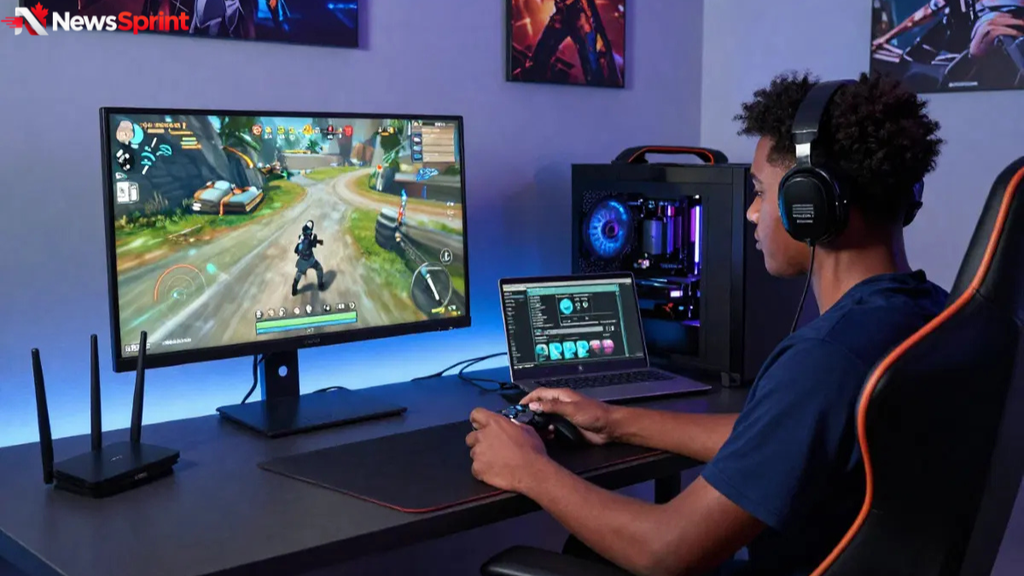
Canadian gamers have different connectivity options depending on their location. A household in a major urban area may have access to fiber, cable, or other broadband services, while a rural household may face different infrastructure and availability limitations.
The appropriate service should be evaluated using actual local availability and the household’s usage patterns. A plan that works well for one address may not be available at another address, even within the same city.
The Canadian Radio-television and Telecommunications Commission provides telecommunications-related information and regulatory resources for Canadian consumers. Its official website is a useful starting point for understanding the Canadian communications environment. CRTC official website
Fiber Internet
Fiber connections transmit data using optical fiber. They are often attractive for households that need substantial bandwidth and reliable performance, although the quality of the complete connection still depends on the provider, local infrastructure, and network conditions.
Fiber can be particularly useful when several household members are gaming, streaming, attending video meetings, or downloading large files simultaneously.
Cable Internet
Cable broadband is another common option in Canada. Its performance depends on the provider’s network design, local congestion, and the service plan.
Cable can support online gaming effectively. It should not be dismissed simply because it is not fiber. The relevant question is how consistently the connection performs at the user’s address.
Fixed Wireless and Other Connections
Some households use fixed wireless or other broadband technologies. These services may be practical where wired infrastructure is limited, but their performance can vary depending on the technology, signal conditions, and local network capacity.
A gaming-focused decision should consider measured latency and reliability rather than relying only on the connection type’s name.
Recommended Internet Speed for Gaming
There is no single internet speed that guarantees an excellent gaming experience for every title, platform, and household.
Traditional online multiplayer games often use less bandwidth than activities such as high-resolution video streaming or large downloads. However, a household with several active devices may need more capacity to prevent competing traffic from affecting gameplay.
Cloud gaming creates different demands because the game is rendered remotely and delivered as a live video stream. For example, NVIDIA GeForce NOW publishes different bandwidth requirements for different streaming resolutions and quality settings. Its official guidance is a useful reference for understanding how cloud gaming needs differ from ordinary locally installed multiplayer games. GeForce NOW system requirements
| Gaming activity | Main connectivity concern |
| Locally installed single-player game | Internet may be needed for downloads, updates, or online features |
| Standard online multiplayer | Stable latency, packet delivery, and sufficient bandwidth |
| Competitive multiplayer | Consistent latency, low jitter, and reliable routing |
| Cloud gaming | Sustained bandwidth, latency, and stable video delivery |
| Gaming with simultaneous streaming | Capacity for gaming and streaming traffic together |
| Multiplayer voice chat | Stable two-way connectivity and sufficient bandwidth |
These are qualitative comparisons, not guaranteed speed thresholds. Actual requirements vary by game, platform, streaming resolution, and household activity.
Ethernet or Wi-Fi: Which Is Better?
Ethernet and Wi-Fi can both support gaming. The better choice depends on the layout of the home, the distance from the router, interference, and the quality of the wireless equipment.
Ethernet connects a device to the router using a network cable. It generally provides a more predictable local connection and avoids many sources of wireless interference.
Wi-Fi offers convenience and flexibility. It is especially useful for laptops, mobile devices, and gaming spaces where running a cable is difficult. Modern Wi-Fi equipment can perform well, but wireless conditions can change as devices move, neighboring networks become active, or household traffic increases.
A practical gaming corner should use Ethernet when it is convenient and safe to install. If Wi-Fi is necessary, the router should be placed sensibly, and the player should test the connection from the actual gaming position rather than assuming that performance near the router will be identical.
Router Settings That Can Help
A router manages traffic between devices in the home and the wider internet. Its configuration can affect the local network experience, especially when several devices compete for bandwidth.
Some routers provide Quality of Service, commonly called QoS. This feature can help manage traffic priorities under congestion. Its usefulness depends on the router’s implementation, the network conditions, and the configuration selected by the user.
QoS is not a universal solution for high ping. It cannot eliminate the physical distance to a remote server, repair every issue on an ISP’s network, or guarantee a particular latency.
Firmware updates can also matter. Router manufacturers sometimes release updates that address security issues, improve stability, or correct software problems. Keeping the router and gaming device updated is a sensible part of maintaining a gaming setup.
Diagnosing Lag in a Gaming Corner
When a game starts lagging, replacing the entire setup is rarely the best first step. A structured check can help identify whether the problem comes from the game server, the internet connection, the local network, or the gaming device.
The first question is whether the problem affects one game or several. If only one game is affected, the issue may involve that game’s servers, routing, or software. If every online game becomes unstable, the local connection deserves closer attention.
The next question is whether other household activities are affected. If video calls freeze, websites load slowly, or downloads become unusually inconsistent at the same time, the issue may extend beyond gaming.
Checking the Connection
A speed test can provide useful information about download and upload performance. However, it should not be treated as a complete gaming diagnostic.
Testing at different times can help reveal whether the problem is associated with peak-hour congestion. Comparing a wired connection with Wi-Fi can also help determine whether the local wireless environment contributes to the issue.
A player should record the conditions under which lag occurs, including the game, server region, connection method, and approximate time. This information can make a support conversation with the internet provider more productive.
Common Causes of Poor Gaming Performance
Network congestion can occur when many devices transfer data simultaneously. A large download, cloud backup, or high-resolution stream may compete with gaming traffic.
Wireless interference can affect Wi-Fi reliability, especially in environments with many nearby networks or physical obstacles. Router placement and the distance between the device and access point may also influence performance.
Server distance is another important factor. A Canadian player connecting to a distant international server may experience more latency than when playing on a nearby server. That difference is not necessarily a sign of poor internet service.
Gaming Corner Zap-Internet and Multiplayer Gaming
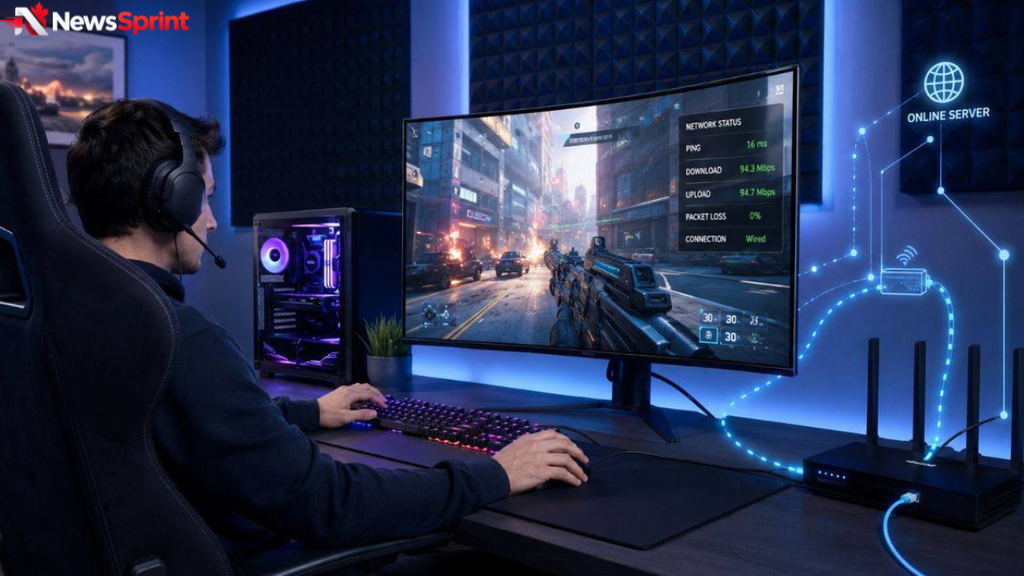
Multiplayer gaming is one of the clearest reasons to pay attention to network quality. In a shared gaming environment, several players may connect to the same local network while communicating through voice chat and downloading updates.
A well-managed gaming zone should account for the combined needs of its users. The number of active stations, the type of games being played, and the capacity of the internet connection all influence how much traffic the network must handle.
A home gaming corner faces a smaller version of the same problem. Multiple family members may use the internet for work, entertainment, education, and gaming at the same time.
The practical lesson is that the gaming device should not be considered in isolation. The whole network contributes to the experience.
Security and Reliability in a Gaming Setup
A gaming corner should also be a secure computing environment. Players frequently use online accounts, digital storefronts, voice-chat services, and payment systems. Protecting those accounts is part of responsible gaming.
Strong, unique passwords and multi-factor authentication can reduce the risk associated with compromised credentials. Players should also be cautious about suspicious downloads, unofficial game modifications, and links shared through unknown accounts.
Shared gaming spaces require additional care. A commercial gaming center may have multiple users accessing the same equipment, so operators need appropriate account-management and privacy practices. Visitors should avoid leaving personal accounts signed in on shared devices.
Security is not a feature that can be guaranteed simply by choosing an internet provider with a gaming-related name. It depends on the devices, software, accounts, and habits involved.
Can a Gaming Corner Improve the Overall Gaming Experience?
A dedicated gaming corner can improve convenience, organization, and comfort. Having the necessary equipment in one place reduces setup time and makes it easier to maintain a consistent gaming environment.
The benefits are not limited to competitive players. A casual gamer may appreciate a comfortable space for single-player adventures, while a group of friends may value a shared arrangement for multiplayer sessions.
However, a dedicated space does not automatically improve game performance. A poorly ventilated room, an unreliable router, or an unsuitable desk can create new problems.
The best setup balances aesthetics with function. Lighting, decorations, and themed accessories can personalize the space, but they should not take priority over safe equipment placement, comfortable seating, and dependable connectivity.
What Canadian Gamers Should Check Before Choosing a Service
Before purchasing an internet plan or paying for access to a gaming venue, the reader should confirm what is actually being offered.
For an internet provider, that means checking the plan’s advertised speed, upload capacity, data policies where applicable, contract terms, installation charges, and service availability at the exact address.
For a gaming cafe or gaming center, it means confirming the station type, available games, hourly pricing, equipment condition, network arrangements, and booking policies.
The name “gaming corner zap-internet” alone is not enough to establish any of these details. The official provider or venue should be the source for current commercial information.
A Practical Comparison
| Evaluation factor | Why it matters |
| Local availability | Determines whether the service can actually be obtained |
| Download capacity | Helps support downloads and shared household usage |
| Upload capacity | Matters for streaming, communication, and uploads |
| Latency consistency | Influences responsiveness in online games |
| Customer support | Useful when persistent connection problems occur |
| Equipment quality | Affects local performance and usability |
| Pricing and terms | Determines the ongoing cost and contractual commitment |
| Privacy and security | Protects accounts and personal information |
This comparison is a decision-making framework, not a ranking of ZAP Internet against Canadian providers. Verified plan details would be necessary to make a meaningful provider comparison.
The Difference Between Marketing and Verified Performance
Gaming-related branding can make an internet service sound appealing. Yet a label such as “gaming internet” does not, by itself, prove that a provider offers specialized routing, guaranteed low ping, or exclusive infrastructure.
Those claims require supporting evidence. A responsible evaluation should look for technical explanations, current terms of service, independent performance testing, and information about the actual service location.
The same principle applies to gaming centers. A venue may advertise high-performance PCs, esports facilities, or premium internet, but customers should verify the available equipment and conditions before assuming that every station offers the same experience.
For readers researching gaming corner zap-internet, this is one of the most important distinctions. The phrase can guide a search, but the decision should be based on independently verifiable information.
Future Relevance of Gaming-Focused Internet
Gaming and internet services continue to overlap as more activities depend on real-time connectivity. Cloud gaming, game streaming, online multiplayer, digital downloads, and social gaming all create different demands on networks.
The direction of the industry suggests that network quality will remain relevant, but the exact requirements will depend on the games, devices, and services people use.
It would be premature to claim that one particular gaming corner concept or internet brand will dominate the Canadian market. There is not enough verified information about a specific ZAP Internet gaming service to support that prediction.
A more defensible conclusion is that gamers will continue to benefit from understanding their own connectivity needs. Choosing a suitable plan and maintaining a practical gaming setup can help them make better use of the games and services they already enjoy.
My Opinion on Gaming Corner Zap-Internet
My view is that the most valuable part of the gaming corner zap-internet concept is its emphasis on the connection between the gaming environment and the internet. Players often spend considerable amounts on hardware while overlooking the network conditions that affect online play.
That does not mean every gamer needs a premium internet package or a dedicated gaming room. A simple gaming station with a reliable connection can be entirely suitable for many users.
The phrase itself should be treated carefully, though. Public information confirms a ZAP Internet Gaming Corner category, but it does not provide enough independently verified detail to establish a distinct gaming service with guaranteed performance or specific Canadian offerings.
For readers, the best approach is to use the topic as a starting point for research rather than as proof of a particular product’s capabilities. Check official information, evaluate the real needs of the household, and avoid paying extra for marketing claims that are not supported by technical evidence.
Frequently Asked Questions About Gaming Corner Zap-Internet
What is gaming corner zap-internet?
Gaming corner zap-internet is a search phrase associated with ZAP Internet’s Gaming Corner content and the broader subject of gaming spaces and internet connectivity. The official website has a Gaming Corner category, but the available evidence does not establish a universal gaming platform or a specific Canadian gaming internet package under that exact name.
Is gaming corner zap-internet a gaming cafe?
There is no verified evidence in the available sources establishing a physical gaming cafe or gaming lounge operating under the exact name Gaming Corner Zap-Internet. Readers should confirm any venue’s address, services, and operating details through an official business source before visiting.
What internet speed is good for online gaming in Canada?
The appropriate speed depends on the game, device, and other household activities. Many traditional online games do not require extremely high bandwidth, while cloud gaming and simultaneous streaming can require more capacity. Stable latency and reliable packet delivery are also important.
Is Ethernet better than Wi-Fi for gaming?
Ethernet often provides a more predictable local connection because it avoids many wireless interference problems. Wi-Fi can also work well when the router, device, and surrounding network conditions are suitable. Testing the actual gaming location is more useful than assuming that either connection type is always perfect.
How can I reduce lag in my gaming corner?
Start by checking whether the issue affects one game or several. Test the connection at different times, compare Ethernet with Wi-Fi when possible, examine background network activity, and check for device or router updates. If the issue persists, contact the internet provider with details about the affected games and connection conditions.
Conclusion
Gaming corner zap-internet is a useful search topic for readers interested in gaming setups, online play, and internet performance. Its connection to ZAP Internet’s Gaming Corner content is documented, but a specific gaming service, physical venue, or specialized Canadian internet package has not been established by the available evidence.
For Canadian gamers, the practical lesson is straightforward: choose equipment that suits the games you play, use a stable connection, and evaluate internet services based on verified information rather than branding alone.
A comfortable gaming corner, sensible network configuration, and realistic understanding of latency can do more for the experience than an expensive setup built around marketing promises and more.
